Video Poker Layered Bonuses: Probability Tables and Their Effect on Return Expectations
Core Mechanics of Video Poker Paytables
Video poker combines elements of slot machines and traditional poker, with outcomes determined by fixed probability distributions across card combinations; players receive five cards drawn from a standard 52-card deck and may hold or discard to form winning hands such as pairs, straights, flushes, and royal flushes, while probability tables list exact frequencies for each hand type and directly feed into return-to-player calculations that operators publish for regulatory compliance.
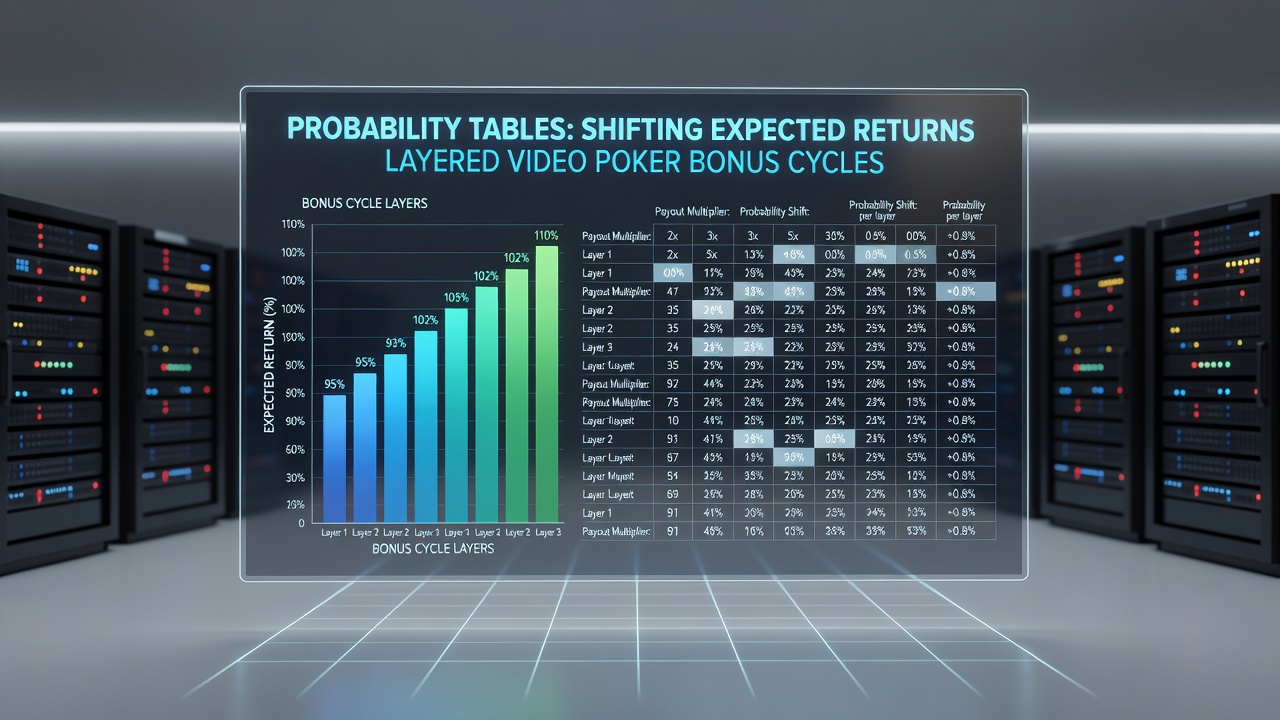
Data from multiple jurisdictions shows that base game expected returns typically range between 95 and 99 percent when optimal strategy is applied, yet these figures assume static paytables without additional bonus layers; once layered bonuses activate, multipliers or progressive elements redistribute the overall return profile because the underlying card probabilities remain constant while payout structures expand conditionally.
How Layered Bonus Cycles Alter Distribution
Layered bonuses often trigger after a qualifying hand appears or after a set number of plays, at which point a secondary paytable applies with enhanced multipliers; researchers at academic institutions have modeled these cycles by recalculating expected value across thousands of simulated hands, revealing that the probability of triggering the bonus remains governed by the same combinatorial math yet the conditional payouts shift the long-term return upward or downward depending on the multiplier depth and frequency caps.
One study released in early 2026 examined multi-tier bonus structures in popular variants such as Jacks or Better and Deuces Wild, finding that a double-or-nothing bonus layer increased overall expected return by 1.8 percentage points when the bonus activation probability sat at 0.12 per hand, while deeper tiers with four-layer multipliers produced diminishing returns once activation rates dropped below 0.05 because rare high-multiplier events could not offset the more common base-game outcomes.
Constructing and Interpreting Probability Tables
Probability tables for video poker list every possible hand outcome alongside its combinatorial count and payout; for a standard Jacks or Better paytable the royal flush occurs once every 40,390 hands on average, the straight flush once every 9,150 hands, and so on down to the pair of jacks or better that appears roughly once every 5 hands, and these frequencies serve as fixed inputs when analysts construct expected-value equations for bonus cycles.
When a bonus layer multiplies all payouts by a factor of three, the table entries are simply scaled before re-averaging against the unchanged probabilities; analysts therefore compare the base expected return against the adjusted figure to quantify the net shift, which can reach several percentage points depending on how frequently the bonus window remains open and whether carry-over features allow unused multipliers to persist into subsequent cycles.
Regulatory Reporting and Data Transparency
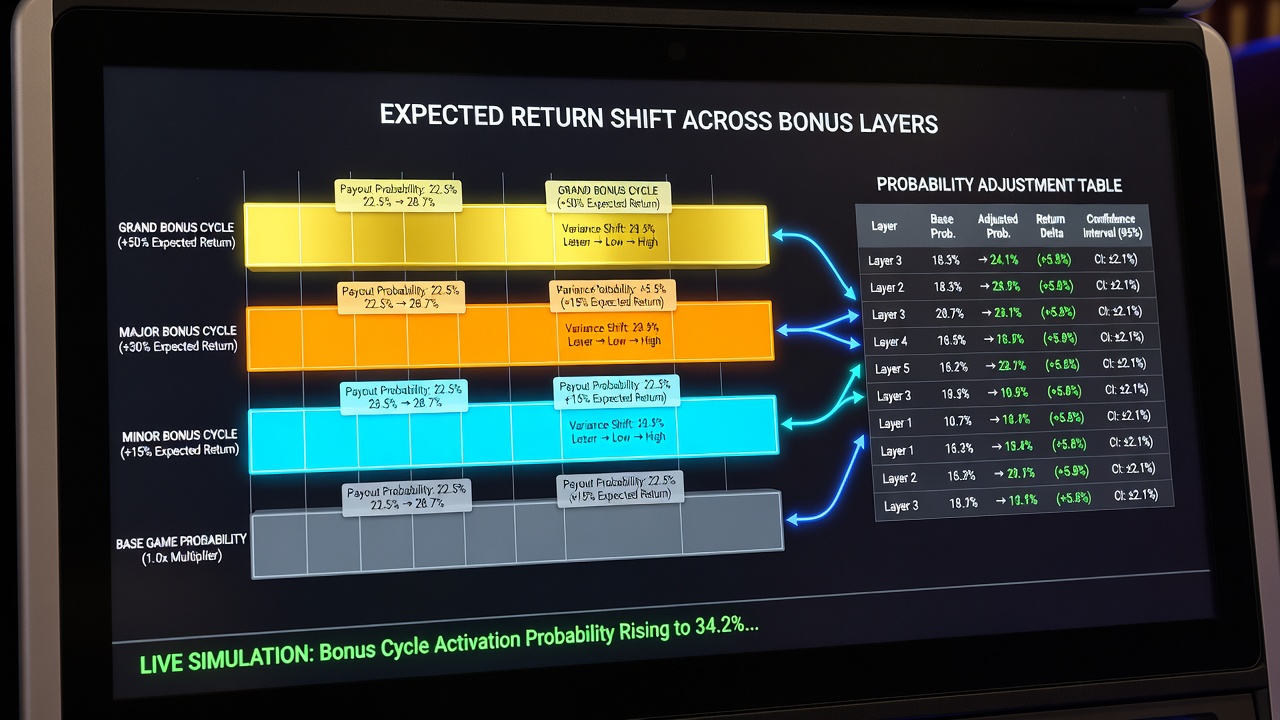
Operators in Nevada must submit detailed return reports to the Nevada Gaming Control Board on a quarterly basis, and similar requirements exist under the Australian Communications and Media Authority for licensed venues; these filings include separate line items for base-game returns and bonus-augmented returns, allowing observers to track how probability-table adjustments manifest in real-world performance data across thousands of machines.
Figures released for the second quarter of 2026 indicated that machines equipped with three-tier bonus cycles posted average returns 0.7 percentage points higher than identical base configurations without the layers, while four-tier structures showed a narrower 0.3-point lift because the highest multiplier tier activated too infrequently to influence aggregate results significantly.
Strategic Implications for Players and Operators
Optimal play strategies must account for the altered paytables that appear only during bonus windows, and software tools developed by independent researchers allow players to input both base and bonus probabilities to generate updated decision matrices; those who ignore the conditional shifts often select suboptimal holds during bonus phases, reducing the theoretical return that the adjusted tables otherwise guarantee.
Operators, meanwhile, calibrate bonus frequency caps and multiplier depths to meet target return ranges required by licensing agreements, with probability tables serving as the primary design instrument because they isolate the exact contribution of each hand type before and after layering occurs.
Conclusion
Probability tables remain the foundational element that determines how layered bonuses redistribute expected returns in video poker, since card-draw frequencies stay fixed while payout multipliers expand conditionally; regulatory filings from 2026 confirm measurable shifts in aggregate returns when bonus tiers activate at documented rates, and continued analysis of these tables enables precise forecasting of long-term performance across different machine configurations and jurisdictional requirements.