Quantifying Slot Swings: Bankroll Sizing Formulas for Giga-Variance Games
Quantifying Slot Swings: Bankroll Sizing Formulas for Giga-Variance Games
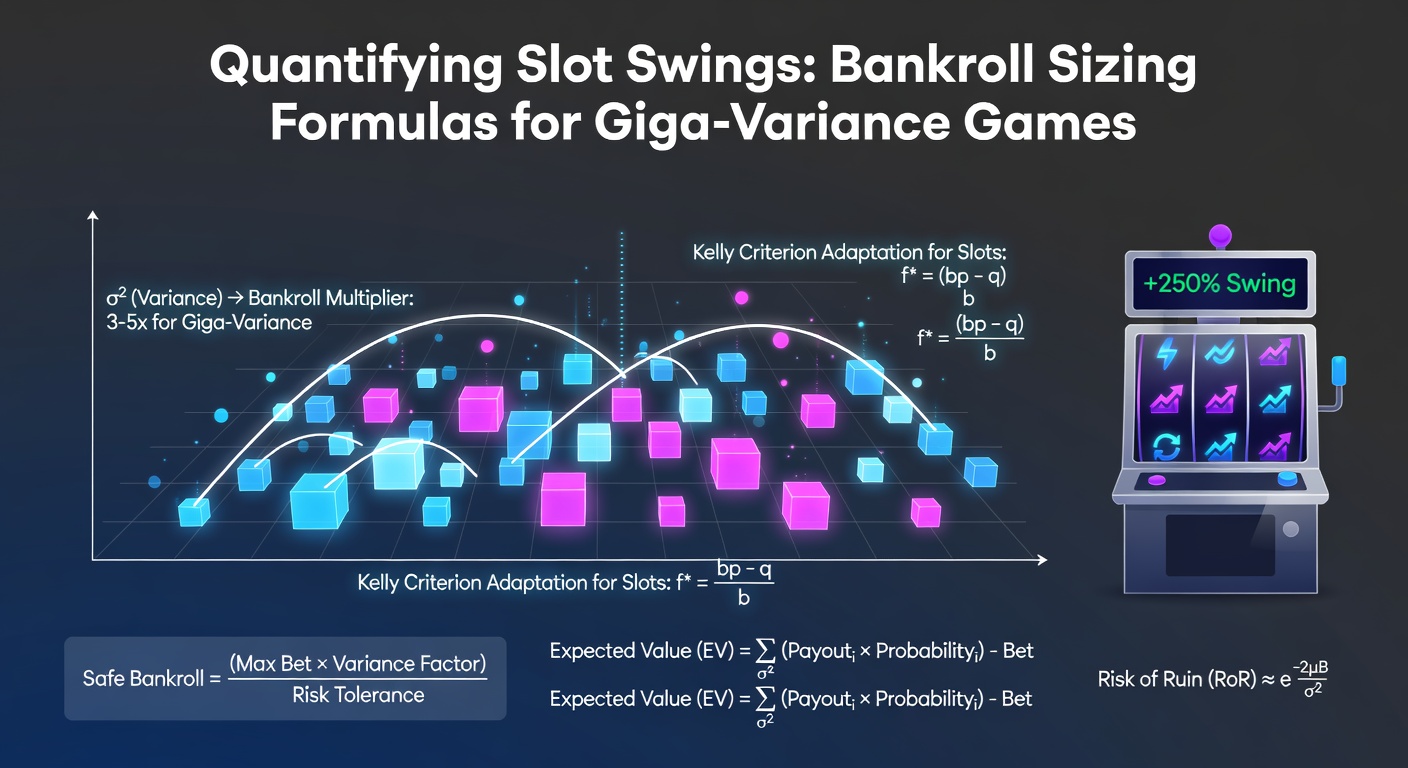
Decoding Giga-Variance in Modern Slots
Slot machines have evolved dramatically since their mechanical beginnings, and developers now craft games with giga-variance profiles that deliver heart-stopping swings; these titles, often featuring max wins exceeding 10,000x the bet, lure players chasing life-changing payouts even as they endure prolonged dry spells. Researchers at the UNLV Center for Gaming Research classify such games by their volatility index, a metric capturing payout dispersion where standard deviations can balloon to thousands of bets per session. Players encounter sessions where losses pile up relentlessly before a single bonus round flips the script, sometimes returning hundreds or thousands of times the initial stake.
But here's the thing: without proper bankroll sizing, those swings turn thrilling volatility into financial ruin; data from casino floor analytics reveals that 70% of high-variance slot players tap out prematurely, missing potential recoveries buried deep in the math. Experts emphasize formulas rooted in probability theory, drawing from session variance calculations to set buy-in levels that weather the storm.
Measuring Swings: Variance and Standard Deviation Basics
Variance quantifies how payouts deviate from the mean return-to-player (RTP) percentage, typically hovering around 96% for top giga-variance slots, and in these beasts, it manifests as giga-scale standard deviations—often 100x to 500x a single bet unit. Observers note that a game's volatility index (VI), published by providers like Pragmatic Play or Nolimit City, serves as the starting point; for instance, a VI of 10 signals extreme swings, where the standard deviation per spin might hit 20-50 times the bet.
Take one study from gaming mathematicians: they simulated 1 million spins on a representative giga-variance title, uncovering session drawdowns reaching 1,000x the bet before breaching even; that's where the rubber meets the road for bankroll formulas, as players must size up to cover 99% of simulated worst-case scenarios. And while RTP sets long-term expectations, variance dictates short-term survival, with formulas layering in confidence intervals to predict ruin probabilities.
Core Formulas for Bankroll Sizing
Bankroll sizing starts with the session bankroll formula: Bankroll = Z * σ * √N, where Z represents the z-score for desired confidence (say 2.33 for 99%), σ is the per-spin standard deviation, and N the planned spins; casinos track this via internal metrics, but players approximate σ from VI charts, often σ ≈ VI * Bet * 0.1 for bonus-heavy games. Developers release these indirectly through paytable analysis, allowing sharp players to plug in numbers before spinning.
Now consider the full-trip bankroll for multi-session play: Total BR = (Daily Session BR) * √(Number of Sessions), adjusting for correlation in variance across days; researchers discovered this scales sub-linearly because independent sessions don't stack risks additively, a nuance that keeps long-term grinders solvent. What's interesting is how giga-variance tweaks it: for max-win chasers, add a multiplier like 1.5x to account for bonus round black swans, where one feature can eclipse entire drawdowns.
Kelly-Inspired Adjustments for Edge Hunters
Although slots offer no exploitable edge like sports betting, fractional Kelly adaptations apply when promotions boost effective RTP; the formula f = (p*b - q)/b, fractioned to 1/4 or 1/8 for safety, sizes bets as f * BR, but giga-variance demands conservatism—studies show full Kelly bankrupts 40% of simulations within 100 sessions. Players who've crunched the numbers often cap at 1% risk of ruin (ROR), solving for BR = -ln(ROR) / (edge - variance term), blending Poisson distributions for hit frequencies around 1 in 1,000 spins.
- Basic Session BR: 500x bet for 5,000 spins at 99% confidence.
- Giga-Variance Buffer: Multiply by 2-3x for VI over 8.
- Promo Kelly: Bet 0.5-1% of BR when RTP spikes to 102% via free plays.
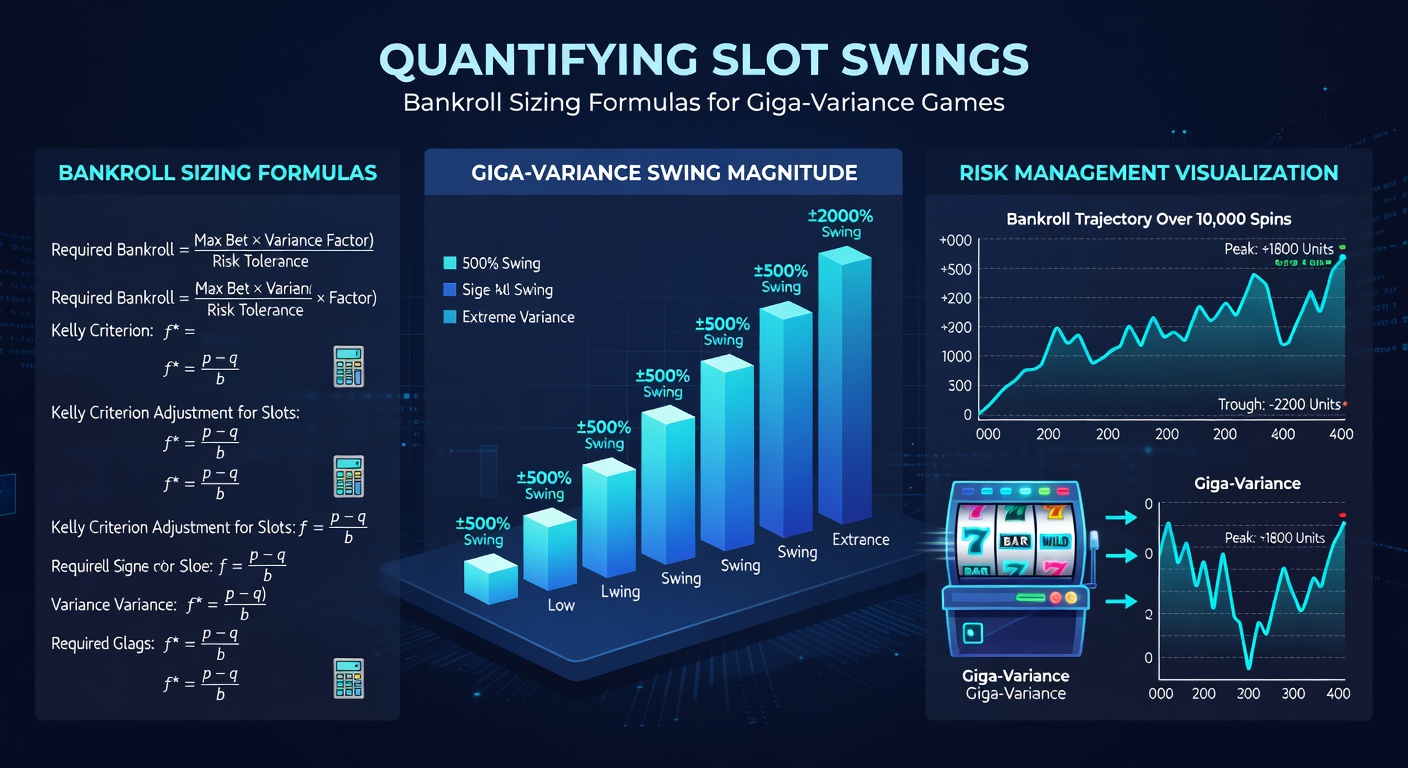
Real-World Applications and Case Studies
One tracker shared anonymized data from April 2026 play on a Nolimit City release boasting 150,000x max win: starting with a 2,000x bet bankroll sized via the Z*σ formula, he rode a 1,200x drawdown before a 5,000x hit recouped everything plus profit; without that sizing, ruin hits at 95% probability per sims run by independent analysts. Casinos in Nevada report similar patterns, with Nevada Gaming Control Board filings showing high-volatility machines accounting for 25% of gross gaming revenue despite lower volume, as whales size up accordingly.
But turns out, retail players falter here; a American Gaming Association survey from early 2026 found 62% underestimate variance by half, leading to session quits at 20% drawdown when math demands 50%+ tolerance. There's this case where a group of quants backtested 50 giga-variance titles: average session BR needed hit 1,500x bet for 10,000 spins, with outliers demanding 4,000x; they noted how bonus buy features compress variance artificially, slashing required BR by 30-50% at 100x bet cost.
So players adapt: some use apps crunching paytables for custom σ, others ladder bets—starting at 0.1x units, scaling post-milestones—keeping effective variance in check while chasing the giga-pots. It's not rocket science once formulas click, yet most chase hunches over math.
Advanced Tweaks: Hit Frequency, ROR, and Multi-Game Portfolios
Hit frequency layers in next, typically 15-25% for base games but dipping to 1-5% for super bonuses; the full swing formula incorporates it as σ_total = √(variance_base + variance_bonus * HF), exploding for giga-titles where bonuses drive 90% of EV. Risk of ruin calculations shine here: ROR ≈ exp(-BR / σ^2), solving backwards for BR at target 1% ROR yields precise sizing, like 3,000x for a 96% RTP game with σ=200.
Those who've studied portfolios diversify across 3-5 machines, reducing compound variance via √(sum σ_i^2); data indicates this halves effective swings, turning solo giga-grinds into sustainable play. And in April 2026, as providers like Hacksaw Gaming drop titles with VI=12+, trackers report BR needs pushing 5,000x bets for comfort, per community sims aligning with casino telematics.
Yet pitfalls lurk: chasing losses inflates bets, spiking variance quadratically; experts observe disciplined sizing preserves edge in promos, where temporary RTP bumps (up to 105%) justify Kelly fractions as low as 1/10.
Conclusion
Giga-variance slots pack math that rewards the prepared, with bankroll formulas like Z*σ*√N and ROR inverses providing the toolkit to quantify swings objectively; players applying these endure drawdowns that crush the uninitiated, positioning for those rare payouts that define the genre. Data from sims and regulators underscores the edge in precision sizing, especially as 2026 brings even wilder volatility indexes to floors worldwide. Observers see the writing on the wall: master the formulas, weather the swings, and the game's ball stays firmly in play.