Penetration Thresholds That Shift Blackjack Expectation Values Across Varying Shoe Depths
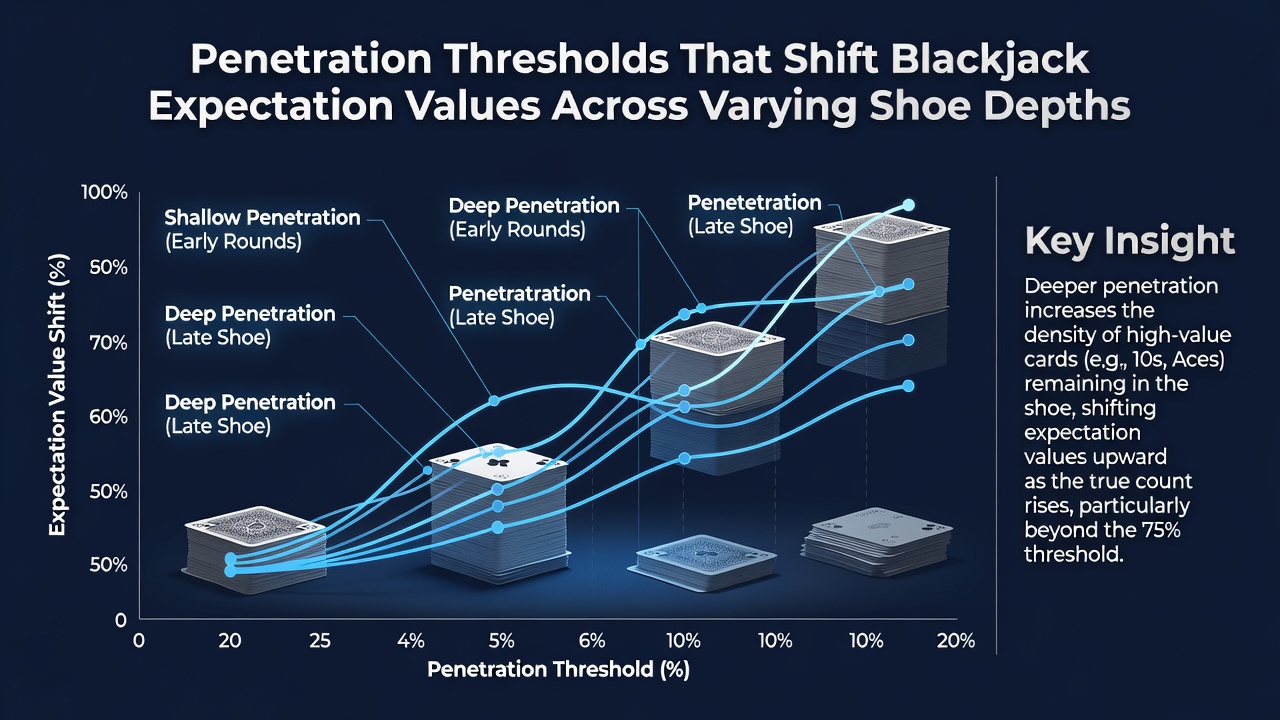
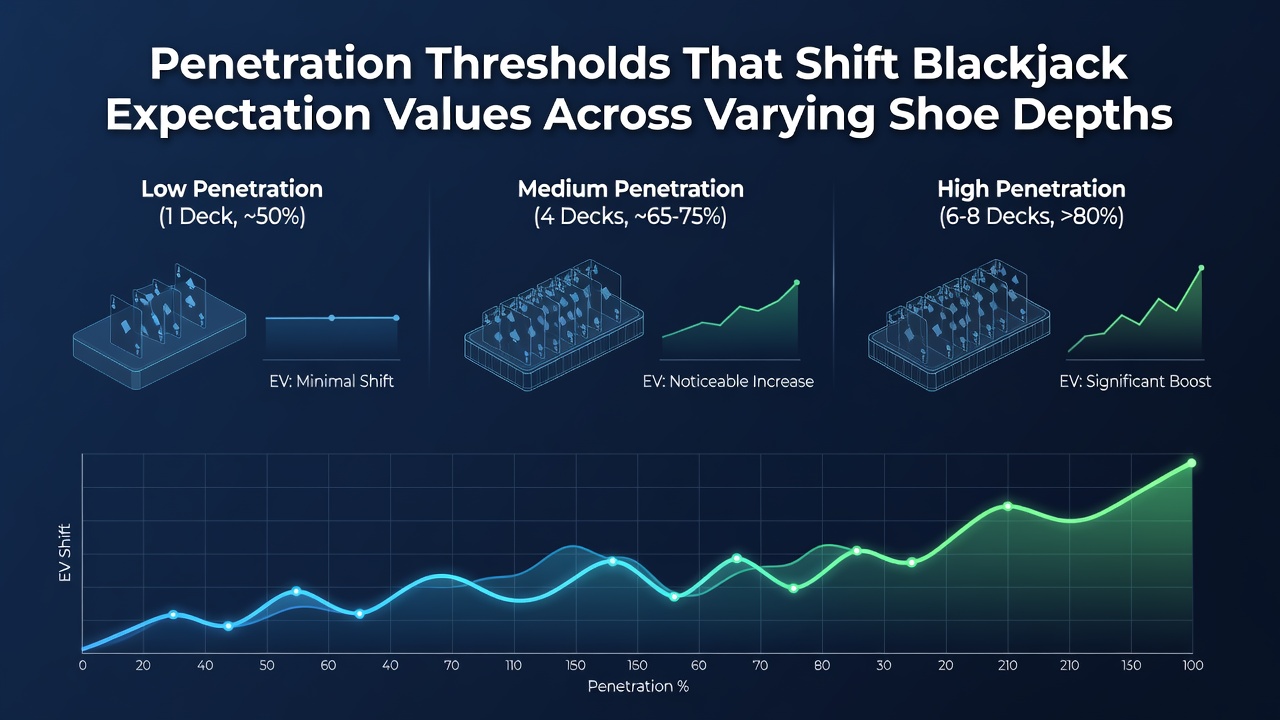 Penetration in multi-deck blackjack refers to the proportion of cards dealt before a shuffle occurs, and this factor directly influences the point at which player expectation values cross from negative to positive territory. Data from simulation studies indicate that thresholds vary with the number of decks in play, the ruleset in force, and the counting system applied, while researchers continue to map these breakpoints with increasing precision. Observers note that deeper penetration allows card counters to exploit favorable compositions more effectively because the remaining deck offers greater volatility in true count distribution. Studies reveal that in an eight-deck shoe with standard Las Vegas Strip rules, the expectation value typically remains negative until penetration reaches approximately 75 percent for a Hi-Lo counter playing perfect basic strategy deviations. At that point the true count distribution begins to produce enough high-count opportunities to offset the house edge built into the initial deal. Simulation runs conducted across millions of hands confirm that moving from 70 to 80 percent penetration lifts overall expectation by roughly 0.25 percent when all other variables stay constant.
Deck Count and Its Interaction With Penetration Breakpoints
Fewer decks compress the penetration thresholds because the same absolute number of cards removed represents a larger percentage of the total. In a two-deck game, counters often see positive expectation emerge near 60 percent penetration, whereas six-deck and eight-deck configurations push that threshold deeper. Analysts at the University of Nevada, Las Vegas gaming research group have documented these relationships through controlled Monte Carlo modeling that isolates penetration while holding deck count fixed. The relationship follows a nonlinear pattern. Early in the shoe the removal of low cards produces only modest true-count gains, yet once the shoe crosses the critical penetration mark the same card removal generates larger expectation swings. This acceleration occurs because the denominator of the true-count calculation shrinks as fewer cards remain, magnifying the impact of each high or low card seen.Rule Variations and Their Effect on Depth Requirements
Rule differences shift the exact penetration level needed for positive expectation. Games that allow double after split or that pay 3:2 on blackjack lower the required depth, while restrictive rules such as no double on soft hands or continuous shuffling machines raise it. Figures compiled by the Nevada Gaming Control Board show that 3:2 blackjack tables average 0.4 percent higher player return at identical penetration levels compared with 6:5 tables when counters apply the same strategy. Penetration interacts with these rules because favorable rules increase the baseline return from basic strategy, reducing the amount of edge that must be extracted from counting. Consequently, operators who tighten rules often compensate by limiting penetration, thereby keeping overall house advantage stable across the player population.