Mapping Expected Value Shifts in Video Poker Variants Under Changing Paytable Structures
Carlo Koch · Jul 29, 2026
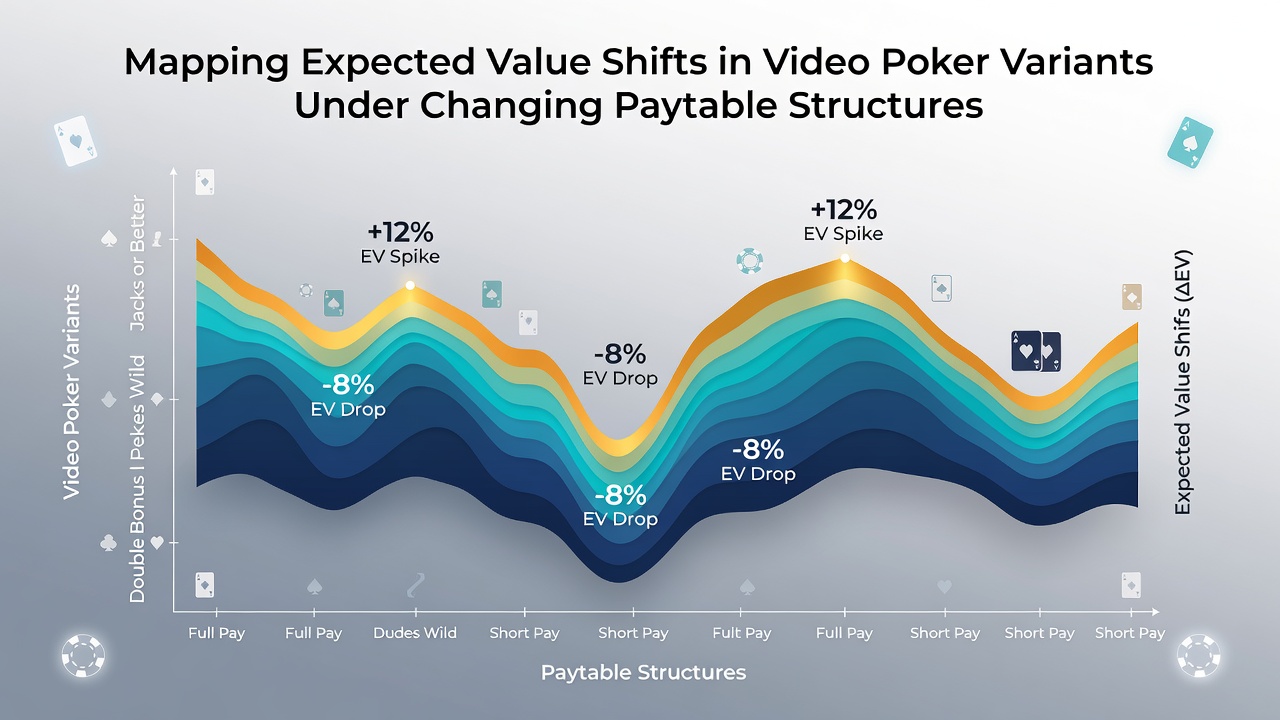
Mapping Expected Value Shifts in Video Poker Variants Under Changing Paytable Structures
Video poker machines display paytables that list returns for each hand ranking, and those tables directly determine the expected value of any given variant. Researchers track how adjustments to individual payouts alter the overall return percentage, which players calculate by multiplying each hand's probability by its payout multiplier and summing the results across all possible outcomes. Data from gaming laboratories show that even small reductions in flush or full house returns can drop a game's long-term expected value by several percentage points.
Core Mechanics of Expected Value in Video Poker
Each video poker hand follows a fixed probability distribution based on the number of cards drawn and the deck composition. Analysts compute expected value by enumerating every possible five-card combination after the draw phase, then weighting those outcomes against the current paytable. When operators modify a paytable entry, such as lowering the royal flush payout from 800 to 700 credits, the entire EV equation shifts because that rare outcome carries substantial weight in the final average. Studies released in early 2026 confirmed that such targeted changes produce measurable drops in return percentages across multiple machine configurations.
Variant-Specific Paytable Sensitivities
Jacks or Better machines rely heavily on the payout for two pair and three of a kind, whereas Deuces Wild variants place greater emphasis on four deuces and wild royal combinations. Observers note that a one-credit reduction in the full house line affects Jacks or Better more severely than it does Double Double Bonus Poker because the latter distributes value across additional bonus hands. In July 2026 several manufacturers published updated paytable matrices that illustrated these differential impacts through side-by-side comparisons of identical starting hands under old and revised schedules.
Practical Calculation Examples
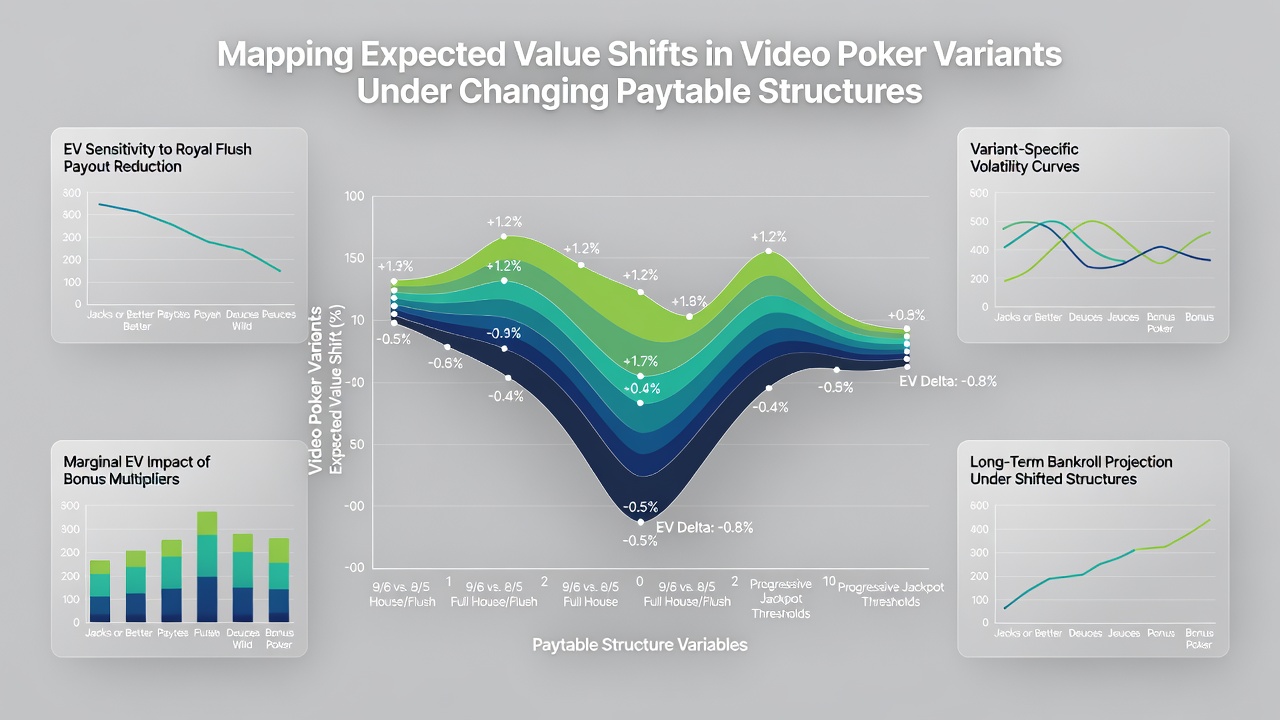
Take one common 9/6 Jacks or Better paytable where a flush returns 6 credits and a full house returns 9 credits. Replacing that schedule with an 8/5 version reduces the flush multiplier to 5 and the full house to 8. The resulting EV decline equals approximately 1.37 percent when all probabilities remain constant. Analysts at academic gaming centers have published spreadsheets that allow direct substitution of new payout values, revealing how each incremental change propagates through the hand-ranking hierarchy.
Double Bonus Poker introduces extra multipliers for four aces and four twos through fours, which creates additional sensitivity points. When operators raise the four-of-a-kind bonus from 80 to 160 credits while simultaneously trimming the straight flush line, the net EV movement depends on the precise probability weighting of those two hand types. Recent simulation runs indicate that the bonus increase can partially offset the straight flush reduction, leaving overall return within 0.4 percent of the original figure.
Regional Regulatory Influences on Paytable Design
Gaming control agencies in multiple jurisdictions require manufacturers to submit detailed EV reports before approving new paytable configurations. The Nevada Gaming Control Board maintains public archives of approved schedules that show how minor wording changes in payout descriptions correlate with measurable shifts in theoretical hold percentages. Similar documentation from the Australian Communications and Media Authority tracks comparable adjustments in international markets, allowing cross-regional comparisons of how identical variants respond to paytable modifications.
Industry groups such as the American Gaming Association have compiled aggregate data sets that track the frequency of paytable revisions across casino floors. These compilations reveal that operators most commonly adjust mid-tier hands such as straights and flushes rather than top-end royal flush lines, because those mid-tier changes produce smaller visible differences to players while still moving the house edge.
Software Tools and Simulation Methods
Commercial video poker analyzers enumerate all 2,598,960 possible five-card combinations from a 52-card deck, then apply each paytable multiplier in sequence. Updated software releases in 2026 added modules that automatically recalculate EV after users input revised payout values, eliminating manual recomputation of probability tables. Researchers at several university gaming programs have validated these tools against independent Monte Carlo simulations, confirming agreement within 0.01 percent across tested variants.
Conclusion
Paytable adjustments produce predictable, quantifiable shifts in expected value that vary according to each video poker variant's hand hierarchy and bonus structure. Systematic mapping of these shifts relies on exhaustive enumeration of hand probabilities combined with direct substitution of new payout values. Regulatory archives and simulation software together provide the factual basis for tracking how operators modify return percentages over time.