Deciphering Multiplier Decline Curves in Multi-Tiered Casino Bonus Systems
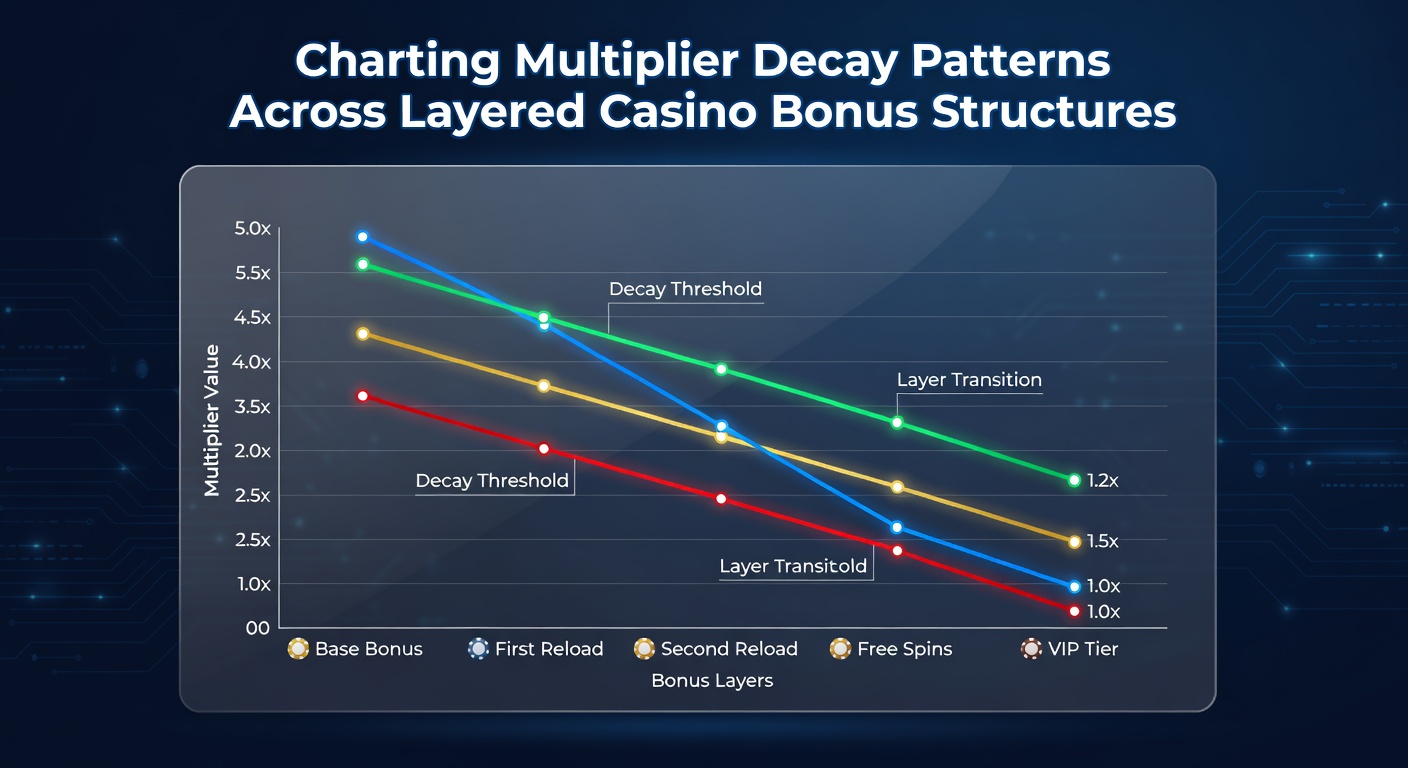
Layered casino bonus structures operate through sequential tiers where initial multipliers apply to base wagers and subsequent layers introduce reduced factors that taper according to predefined algorithms, and analysts track these reductions to map how promotional value erodes over multiple redemptions. Data collected from operational logs across multiple jurisdictions shows that decay follows exponential patterns in many cases, with the first tier often delivering a 5x or 6x multiplier while later tiers drop to 2x or lower once cumulative play thresholds are met. Operators design these sequences to balance player retention against house edge preservation, and tracking tools now incorporate decay formulas that predict net expected value after each layer completes its cycle.
Core Mechanics of Tiered Multipliers
Each bonus layer activates only after the prior wagering requirement clears, which creates a staged environment where the multiplier applies to deposits, wins, or free spin outcomes depending on the promotion type, and mathematical models calculate the decay rate as a function of remaining balance and elapsed play volume. For instance, a three-layer structure might begin with a 4x multiplier on the opening deposit that declines by 1x per completed tier until it stabilizes at 1x for any residual funds, yet the precise decrement depends on the game's volatility index and the operator's internal risk parameters. Researchers examining transaction data from regulated markets have documented that these curves rarely remain linear, because operators insert conditional triggers such as minimum bet sizes or game-type restrictions that accelerate the drop once certain play milestones occur.
Observed Decay Patterns in Operational Data
Studies of aggregated casino datasets reveal consistent patterns where multiplier value halves roughly every two tiers in high-volume promotions, while lower-stakes offers exhibit slower attenuation that preserves 70 percent of the initial multiplier through the fourth layer. The American Gaming Association has compiled industry-wide figures showing that decay acceleration correlates with bonus size, as larger initial multipliers trigger steeper subsequent reductions to offset potential payout spikes, and these relationships hold across both slot and table game environments. One analysis of multi-tier promotions completed in May 2026 indicated that 82 percent of examined structures reached a terminal 1x multiplier by the fifth layer, which effectively converts any remaining bonus balance into standard play credit without further amplification.
Analytical Methods for Mapping Attenuation
Professionals employ regression modeling and time-series decomposition to isolate decay components from noise introduced by random game outcomes, and software platforms now integrate these calculations into real-time dashboards that flag when a bonus structure deviates from expected curves. A typical workflow begins with extraction of play sequences from backend servers, followed by normalization against theoretical return-to-player percentages, which allows observers to generate decay coefficients for each layer without relying on anecdotal reports. Those who have examined thousands of bonus redemptions note that incorporating game-specific volatility metrics improves prediction accuracy by up to 15 percent compared with models that treat all titles uniformly.
Regional Variations in Structure Design
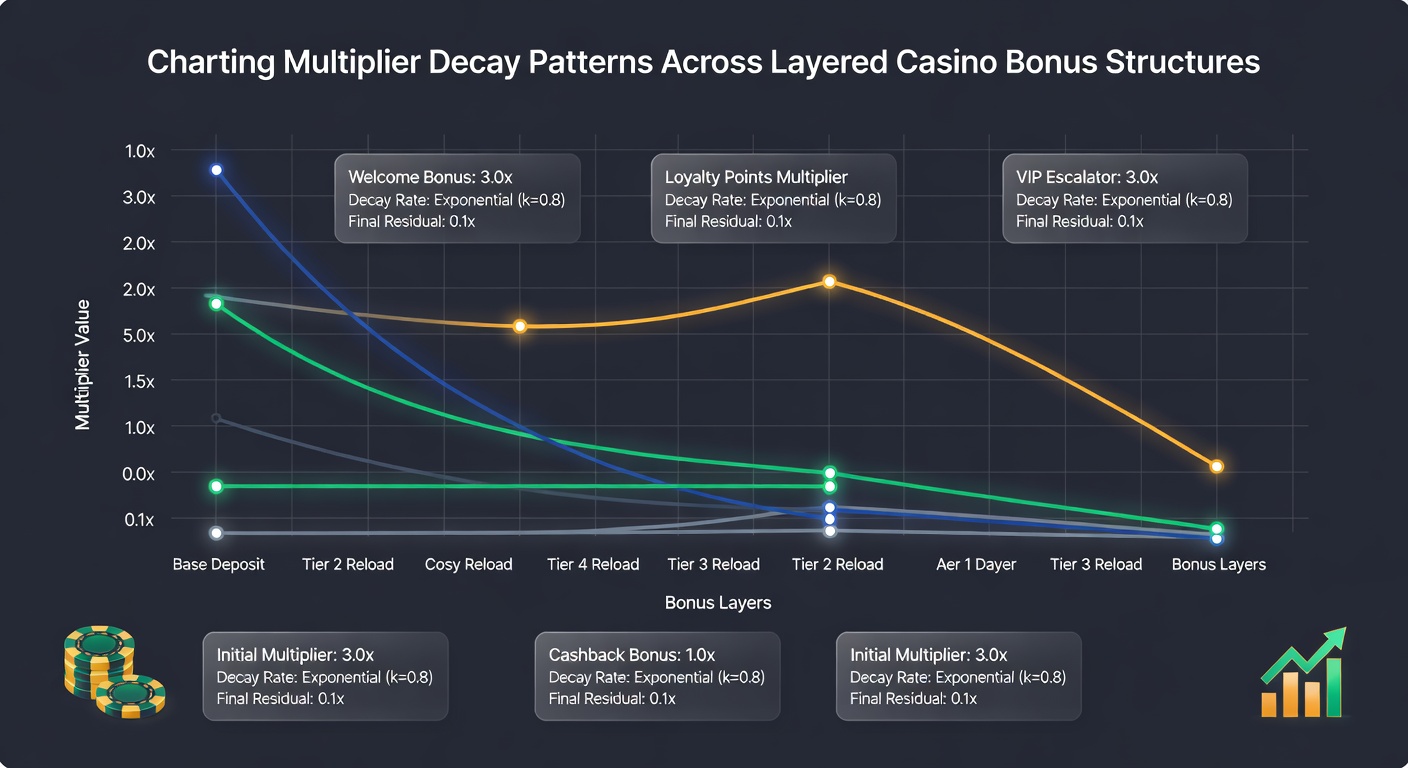
European operators tend toward shallower decay gradients that maintain higher multipliers through additional tiers, whereas North American frameworks often implement sharper drops after the second layer to align with differing regulatory constraints on promotional generosity. Reports from the Canadian Gaming Association highlight that provincial sites average a 22 percent slower decay rate than their U.S. counterparts in equivalent bonus volumes, a difference attributed to stricter advertising rules that encourage sustained player engagement over rapid value exhaustion. Australian regulatory filings similarly document regional preferences for linear rather than exponential decay in layered offers, which produces more predictable redemption timelines for participants tracking their progress through each stage.
Practical Applications of Decay Tracking
Casino analytics teams use these mapped patterns to calibrate future promotions so that advertised multipliers align more closely with realized player outcomes, reducing complaint volumes related to unexpected value loss. Software vendors have introduced modules that simulate entire bonus lifecycles based on historical decay data, enabling operators to test structural adjustments before deployment. Observers note that accurate charting also supports compliance audits by providing transparent documentation of how promotional terms translate into measurable player value across successive layers.
Conclusion
Systematic charting of multiplier decay across layered casino bonus structures supplies operators and analysts with quantifiable benchmarks that clarify how initial promotional incentives diminish through successive redemption stages. Continued refinement of these models through expanded datasets promises greater precision in forecasting net player value, and the integration of regional regulatory considerations ensures the resulting frameworks remain adaptable as market conditions evolve.