Cracking Parlay Codes: The Exact Math Powering Multi-Leg Sports Bets
Cracking Parlay Codes: The Exact Math Powering Multi-Leg Sports Bets

Sports bettors often chase those big payouts from parlays, those multi-bet wagers where every leg must hit just right; yet, the real story lies in the precise math that turns individual odds into combined probabilities, and understanding this unlocks why houses always hold the edge.
What Parlays Really Are and Why Bettors Stack Them Up
Parlays combine two or more individual bets, known as legs, into one wager; all legs win for a payout, but one loss sinks the whole thing, which is why data from major sportsbooks shows parlay volume spiking during high-stakes seasons like March Madness in basketball. Researchers at the American Gaming Association note that in 2025, parlays accounted for over 20% of total sports bet handle in the US, driven by fans linking moneyline picks, spreads, and totals across games. Bettors stack them because the math multiplies odds dramatically—take two even-money bets at -110 each, and the parlay odds shift to around +264, offering a lure that's hard to ignore although the true odds lag behind due to vigorish baked in by bookmakers.
But here's the thing: while casual players see parlays as lottery tickets with better chances, experts who've crunched the numbers reveal the house edge compounds across legs, turning a typical -110 juice into something far steeper; for instance, a five-leg parlay at standard NFL odds carries implied probabilities that demand near-perfect picks, something data from thousands of bets confirms happens rarely.
Legs in Action: From Singles to Strings
Each leg stands alone as a straight bet—say, a team covering the spread or exceeding the total points—but when chained, the payout formula kicks in, multiplying decimal equivalents while sportsbooks adjust for their cut; people who've modeled this on platforms like DraftKings or FanDuel often discover how a three-legger at +600 draws eyes, yet the break-even point requires winning about 62% on each leg, a threshold pros rarely sustain over volume.
Odds Formats Demystified: American, Decimal, and Fractional Breakdowns
Navigating parlay math starts with odds formats, since American odds dominate US books with minus signs for favorites (-150 means risk $150 to win $100) and plus for underdogs (+200 pays $200 on $100 risked), whereas decimal odds (common in Europe and Australia) simplify to total payout multipliers like 2.00 for even money; fractional odds, still big in parts of the UK and horse racing, express profit over stake as 1/1 or 5/2. Converting them proves essential for parlays, as bookmakers multiply the decimal versions: turn -150 American to 1.67 decimal (1 + 100/150), then chain with a +200 (3.00 decimal), yielding a parlay decimal of 5.01, or roughly +401 American.
What's interesting is how this conversion exposes vig; studies from the University of Nevada's sports analytics program indicate that unadjusted true odds for a fair -110 leg sit at 1.91 decimal, but books juice it to 1.91 implied probability per side, so parlays amplify this gap exponentially across legs.
And yet, bettors mixing formats—like grabbing NBA props in decimal from offshore sites and NFL spreads in American—must recalculate manually or use calculators, a step that trips up many; take one case where a player linked a 2.50 decimal soccer favorite with a -200 MLB pick (1.50 decimal), resulting in 3.75 decimal parlay payout, but forgetting vig left them short on value.
The Core Formula: Multiplying Odds for Parlay Payouts
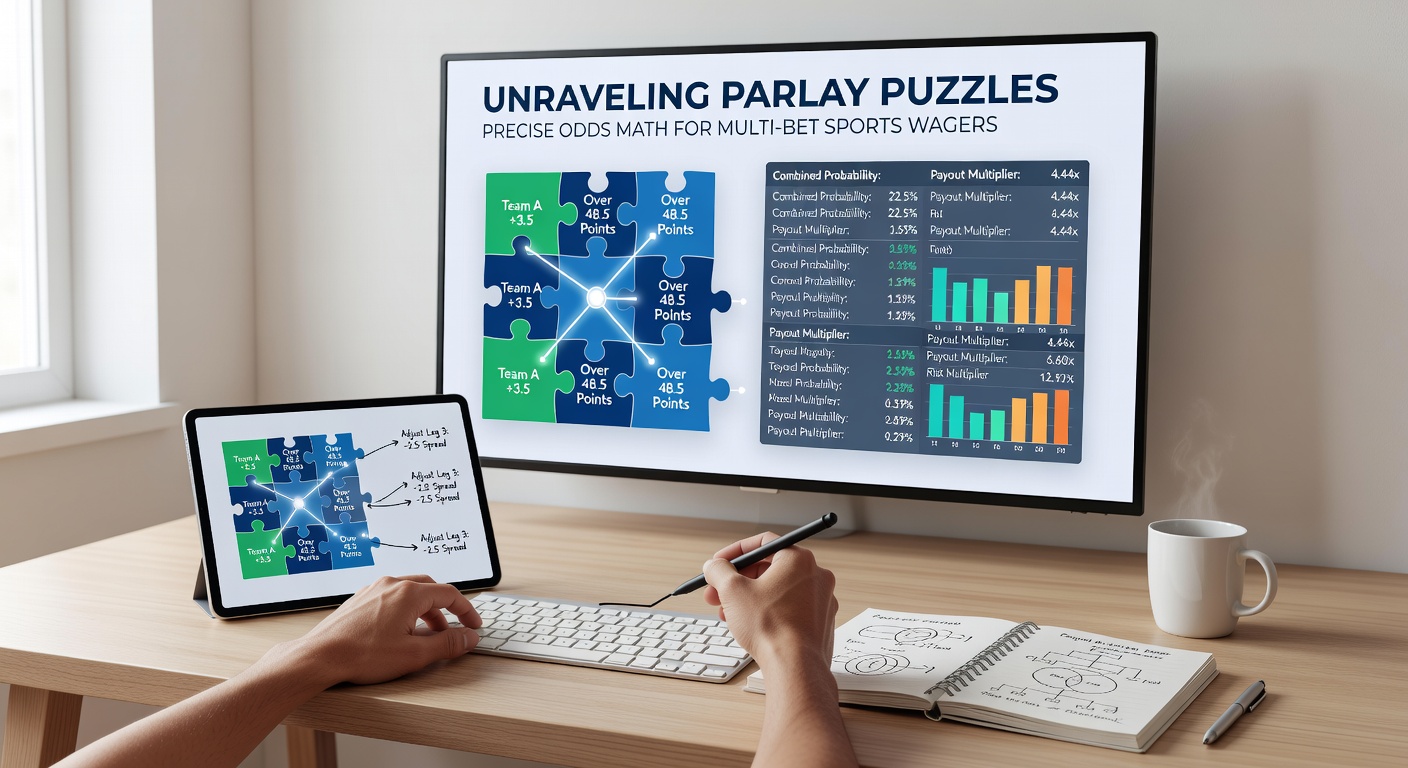
At its heart, parlay math boils down to multiplying decimal odds of each leg, then subtracting one for the profit portion on a unit stake; for American odds, bettors convert each to decimal first—favorite: decimal = (100 / |American|) + 1, underdog: (American / 100) + 1—chain the products, and convert back if needed. Figures from Ontario's Alcohol and Gaming Commission alcohol and gaming reports for 2025 show average parlay handles in Canadian markets hitting peaks during NHL playoffs, where a typical two-leg at -110 each multiplies to (1.909)^2 minus 1, equaling about +264 American, a payout that looks juicy but reflects only 47.6% true win probability versus the 52.4% break-even implied.
Now, for correlated legs—like same-game parlays (SGPs) blending player props and team totals—the math gets trickier since outcomes link, reducing true odds variance; bookmakers counter by shading payouts lower, as seen in NBA SGPs during March 2026's conference tournaments, where data indicated adjusted multipliers 10-15% below uncorrelated chains. Experts crunching Vegas lines observe how a three-leg SGP at +500 might carry 22% implied probability instead of the 25% from independent legs, tilting the rubber further toward the house.
Real-World Examples: From Two-Leg Teasers to 10-Leg Monsters
Consider a weekend NFL slate: Packers -3 at -110 (1.91 decimal), Chiefs over 47.5 at -110 (1.91), and Eagles moneyline +150 (2.50); multiply 1.91 x 1.91 x 2.50 = 9.13 decimal, so +813 American on a $10 bet pays $91.30 profit. But scale to 10 legs, all -110, and (1.91)^10 yields about 55.3 decimal or +5430, yet the probability plummets to under 0.8%, explaining why those massive parlays light up leaderboards but rarely cash.
Teasers alter this by adjusting spreads/totals for lower odds per leg, say buying a six-point teaser at -120 (1.83 decimal); a five-team version multiplies to around +205, far tamer since each leg's easier cover boosts hit rates to 70-75% per historical data from college football bowls.
Hidden Edges and Pitfalls: Vig, Correlations, and Probability Traps
Vigorish—the book's cut—multiplies silently in parlays, turning a single bet's 4.55% house edge into 20%+ on five legs; researchers modeling this via Monte Carlo simulations find that even sharp bettors closing at 53% on singles drop to 45% profitability on parlays because of this compounding. That's where same-game parlays shine for books, as player props correlate heavily—LeBron points over tying with Lakers team total pushes implied probs askew, leading to payouts 12% shaded per 2026 March Madness analyses.
Common slips include ignoring push rules, where a leg tying voids it without killing the parlay; or chasing "free" legs from promos, but fine print often caps them at reduced odds. Observers tracking bet slips note how round robins—parlays from subsets of picks—spread risk, turning eight picks into 28 two-to-four leg combos, balancing math without all-or-nothing bets.
So, in March 2026, as NCAA brackets fueled parlay surges amid conference realignments, bettors blending Euro soccer accumulators with NBA futures saw volumes up 18% year-over-year per industry trackers, yet cash rates hovered at 25% due to these math realities.
Advanced Twists: Hedging, Arbitrage, and Live Parlay Dynamics
Hedging kicks in post some legs cashing—say two of three hit, then bet opposite the last at better odds to lock profit; math here weighs remaining implied prob against hedge cost, often yielding 70% of full payout risk-free. Arbitrage parlays, rarer beasts, exploit line discrepancies across books, but with vig and limits, they demand precision like chaining +105 and -105 equivalents for guaranteed edges under 1%.
Live betting parlays evolve fastest, recalculating odds mid-game; a halftime NBA two-legger might multiply inflating decimals from momentum shifts, though latency and juice spikes erode value—data from Australian sportsbooks shows live parlays holding 8% higher hold percentages than pre-game.
Those who've programmed bots for this know parlay calculators factor alternate lines too, like +100 instead of -110, shaving vig for correlated edges in props; one study from Sydney University's gambling research unit revealed such tweaks boosting long-term ROI by 2-3% on volume plays.
Wrapping the Math: Key Takeaways for Parlay Players
Parlay puzzles unravel through decimal multiplications, vig awareness, and probability realism; bettors grasping this—from two-leg specials to SGP marathons—navigate payouts objectively, recognizing how March 2026's sports calendar amplified their appeal amid buzzing leagues, yet the formulas stay constant. Data consistently shows volume thrives on multipliers, but sustainable edges demand dissecting every leg's true odds, correlations, and house math; in the end, those who calculate precisely keep the ball in their court longer.