Bayesian Inference Methods Drive Real-Time Hand Range Refinements in Heads-Up Poker
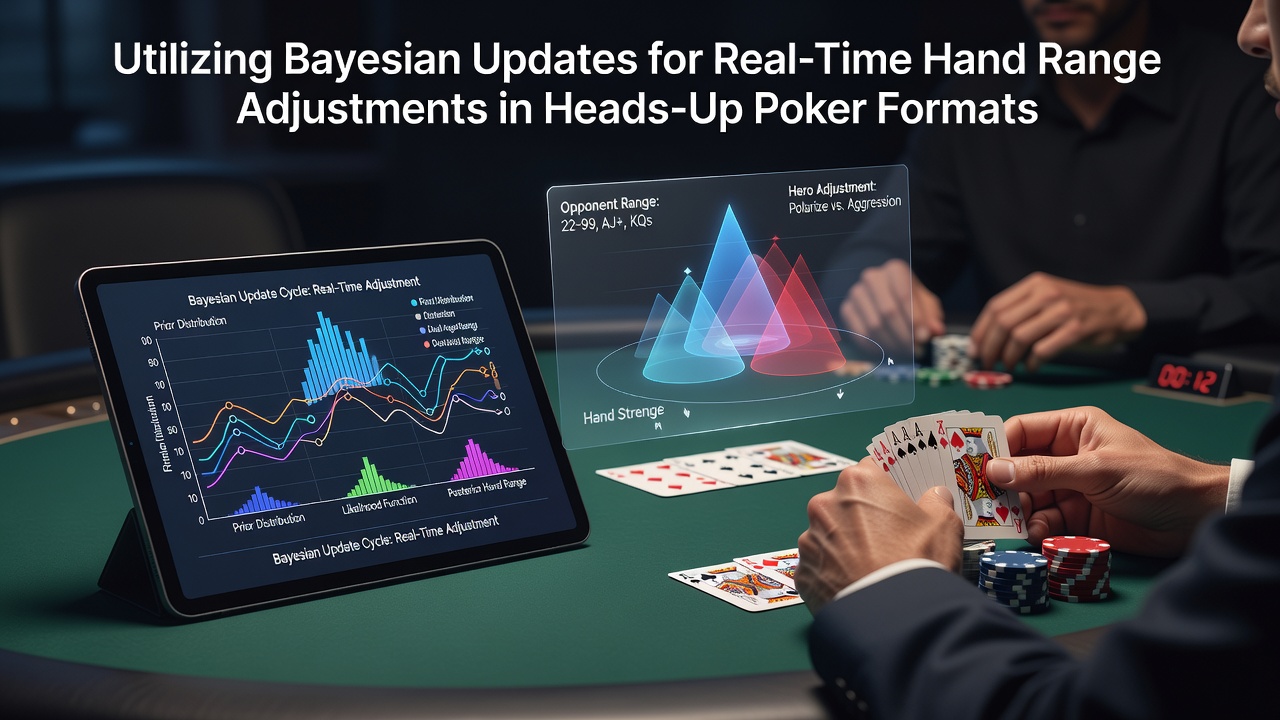
Bayesian updates provide a structured framework for revising probabilities as new evidence arrives, and poker players apply these principles to adjust opponent hand ranges during heads-up matches. Researchers developed the approach by combining prior distributions of starting hands with likelihoods derived from observed actions such as bets, calls, and folds. The process begins with an initial range estimate based on position, stack sizes, and historical tendencies, then incorporates each new piece of information to narrow or expand that range.
Foundational Concepts Behind Range Estimation
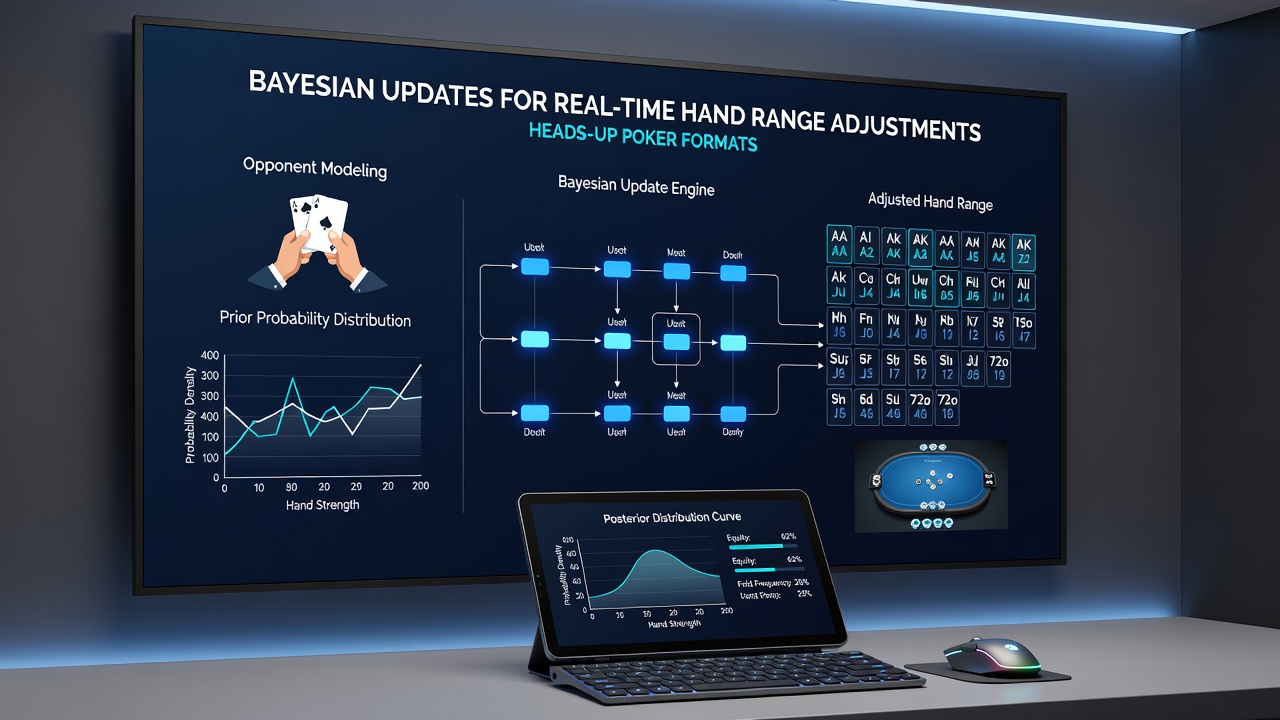
Heads-up formats create frequent decision points because only two players contest each pot, which increases the value of accurate range reading. A starting range consists of all possible holdings an opponent might have, weighted by their frequency of entering the pot from a given seat. Observers note that professionals assign these frequencies using large databases of played hands, while recreational participants rely on observed patterns at the table. Bayesian methods formalize the updating step by multiplying the prior probability of each hand by the likelihood that the opponent would take the observed action with that hand, then normalizing across the entire range.
Board texture changes supply additional evidence at each street. When a flop arrives, certain hands gain or lose equity, and players recalculate posterior probabilities accordingly. Data from simulation studies shows that ranges tighten dramatically after continuation bets on dry boards, whereas wet boards preserve broader distributions because more hands retain equity.
Sequential Updating During a Single Hand
Real-time application requires rapid computation between streets. Software tools precompute equity grids and likelihood tables so that each new action triggers an immediate recalculation rather than a full simulation from scratch. One documented workflow begins with a preflop range of roughly 15 percent of hands for an early-position raise; after a flop continuation bet on a coordinated board, the posterior range might shrink to 8 percent once missed draws and weak pairs receive lower likelihood scores.
Turn and river cards introduce further constraints. A player who called a flop bet but folds to a large turn bet reveals information that Bayesian models translate into reduced weight on marginal made hands. Studies from game-theory research groups indicate that consistent application of this updating process improves expected value over static range assumptions, particularly when opponents exhibit predictable bet-sizing patterns.
Integration With Modern Analysis Platforms
Commercial poker tracking programs now embed Bayesian modules that update ranges automatically based on user-defined priors and observed statistics. These systems pull data from millions of hands to calibrate likelihood functions for specific player pools. In July 2026 several platforms introduced cloud-based solvers that perform the normalization step server-side, reducing latency for players who stream multiple tables simultaneously.
Academic groups have published open-source libraries that implement the same mathematics. The University of Alberta Computer Poker Research Group maintains repositories containing example code for sequential Monte Carlo approximations that handle continuous bet sizes, while the University of Sydney's game-theory laboratory released a paper detailing Dirichlet prior constructions suited to small sample sizes typical of live play. Practitioners access these resources through university websites and adapt them for personal use.
Practical Examples From Tournament and Cash-Game Settings
Consider a heads-up cash-game scenario where the button raises to 2.5 big blinds and the big blind defends. The initial prior assigns approximately 22 percent of hands to the big blind's calling range. After a flop of king-seven-deuce rainbow and a check-call, Bayesian revision lowers the probability of ace-high and queen-high holdings while increasing weight on top-pair combinations and strong draws. A subsequent turn bet from the button further reduces the posterior probability of second-pair hands because the likelihood of calling twice with those holdings declines sharply.
Tournament examples follow similar logic but incorporate stack-depth and payout considerations into the prior. Short-stack players receive narrower ranges in early stages because survival incentives alter raising frequencies. Observers have recorded that players who maintain separate priors for different stages of a tournament achieve more accurate posterior estimates when ICM pressure intensifies near final tables.
Limitations and Calibration Requirements
Bayesian models depend on accurate likelihood functions, which players derive from either personal observation or aggregated database statistics. When sample sizes remain small, variance in the likelihood estimates can produce unstable posteriors. Several research papers recommend hierarchical models that borrow strength across similar player archetypes to stabilize updates until sufficient individual data accumulates. Opponents who deliberately vary their strategies also introduce model misspecification, because the assumed likelihoods no longer match actual behavior.
Regulatory bodies in multiple jurisdictions, including the Nevada Gaming Control Board and state gaming laboratories in New Jersey, require operators to disclose any automated decision-support tools offered to players. These disclosures ensure that Bayesian software remains within permitted analytical boundaries and does not cross into prohibited real-time assistance categories.
Conclusion
Bayesian updating supplies a mathematically coherent method for revising hand-range estimates as each new action and card arrives in heads-up poker. The technique integrates prior knowledge with observed evidence through sequential multiplication and normalization steps. Software implementations reduce computational burden, allowing players to maintain dynamic ranges across multiple streets. Research institutions continue to refine prior constructions and likelihood models, while regulatory frameworks in several regions monitor the deployment of such analytical aids. Continued development of these methods depends on access to large, anonymized hand databases and ongoing academic collaboration across institutions in North America and Australia.